Showing posts with label load testing. Show all posts

Wednesday, April 10, 2019

7 Quick Steps to Become a Great Automation Testing Engineer


Image result for Automation Testing
Test Automation Engineers may save you out of the entire world packed with codes."

Enterprises fully agree with this the particular announcement, also this could be the main reason that you find a good deal of labour opportunities in automation testing industry. I know the reason why Trainers are looking in the direction of this being a livelihood opportunity.

I have been receiving lots of reply asks on Quora associated with livelihood choices in automation analyzing and also how individuals can adapt to automation studying with or with no knowledge in manual testing.

Here I am going to explain at the length that the seven most important steps to becoming a check automation engineer. Thus, all you folks looking to change their career to automatic testing, pay due attention to all of these:

1. Don't Ignore Manual Testing

Even though I understand that businesses are still going in the direction of codeless automated testing applications, to accomplish an expert degree and also to stay informed about your rivalry of automation evaluation engineers at the business, it's exceedingly essential to centre on manual testing theories initially.

Initial I would like to emphasize the truth of making use of automated and manual testing. An article on when to use manual testing and also if to use automated testing can really give you the capacity to comprehend the gap between them.

Once you are finished with those differences, you will understand that automation studying is absolutely an alternative manual testing, but only to some specific extent. So, there is no way you can refrain from programming.

This makes a point very apparent that automation testing is to get seasoned guide testers. Possess Excellent Technical Programming Capabilities

2. Possess Excellent Technical Programming Skills

"Can I find automated testing with no programming abilities "
"Do you want coding skills to discover automatic testing?"
Many of the people who come up with the thought of shifting to automated testing wish to skip the programming part. They have no programming knowledge or else they hate programming.
But like I said within my own the previous stage, this you need to be somewhat proficient with guide testing knowledge to become great automation analyzing scientist for a long-term livelihood while in the application testing industry.

If you Are a Newcomer to the testing industry, one Should have knowledge of the following programming languages:
·         C/C++
·         Java
·         SQL
·         Python
·         Perl
·         XML
·         HTML
·         CSS
Subsequent will be the technical abilities that a guide tester must master to become a fantastic automation analyzing engineer:
Test architecture.
Evaluation layout.
Performance testing.
Setup management.
Guide analyzing agility & discussion.
Communicating between teams.
Agile, DevOps, also constant Shipping.

The combination of most of them abovementioned skills might enable you to relocate to automated testing easily and effortlessly.

3. Know the Application Properly

When you go into a doctor, the doctor should truly have the comprehensive info regarding your past and existing medical difficulties, old healthcare prescriptions, etc.. Just after that will your physician find a way to understand your brand-new health issues and symptoms. Same is how it is using the automation testing scientist. Automated testing engineers want to comprehend the application of the application underneath analyzing inside and out.

·         The most Typical application particulars That Each and Every automation tester Should Look after are:
·         Which programming languages are used though developing the applying?
·         On what stage would be your applying assembled?
·         Which databases are included?

Image result for Automation Testing

·         Are there some software automation testing services/APIs associated with various portions of the program? Exactly how?

  • ·         What's the aim of the dog owner developing this application?
  • ·         What are the functions and features predicted from your application under evolution?
  • ·         HAS manual testing been executed inside this software?
  • Just how several manual hours have been used on this application testing?
  • Is there some current serious problems or glitches bugs?
  • What is your predicted delivery date of the applying?
  • These are merely two or three points and it could vary depending on the intricacy of the software. Thus, be certain that you are entirely thorough with the applying which you're going to test by means of automation analyzing.


4. Experience the Disk Testing Tools

After understanding how to become a smart automation testing engineer, in case we don't talk regarding the evaluation automation instruments, then we are performing an insult to the business.
The main part of these businesses has started applying automation analyzing tools. The primary reason for with them will be that their benefits to the ventures.

Thus, to secure better vulnerability on your career, you would want to test out the top test automation resources offered in the industry. Experimenting with those tools may assist you in getting significantly understanding about their structure, environment, feasibility for your own applications under tests, plus a lot more.

Furthermore, acquiring good working experience with such applications will help you to decide on which tool fulfils all of your automation analyzing requirements. This can assist you more in your career the moment it comes to executing on your testing projects.

5. Determine ATLC Methodology

ATLC Is Short to get Automation Testing Life Cycle.
How we follow exactly the life span of applications testing and development, same is the way for automation analyzing also. To understand and follow the ATLM, One Ought to Get expertise of the next:

·         Decision earning testing.
·         Exam automation tools.
·         Automation testing process.
·         Test preparation, design, and evolution.
·         Evaluation of script execution and management.
·         Evaluation and analysis of test apps.
For each test automation demands, a test automation engineer follows this specific lifetime cycle:
Automated Testing Lifecycle
For a thriving automation evaluation helper, you need to comprehend the ATLC methodology and also execute it in your daily test automation project.

6. Create a Test Automation Method

Once you're finished with all the ATLC methodology and also the automated testing tools, then you're well ready to create your test automation plan for your customers or company.

To be a great automation test scientist, you could certainly be the best man to initiate together with preparing the exam automation strategy, finalizing the various tools, entire the price tag and ROI calculation.

Automation strategy production is believed to become a very crucial part as you'd need to define and create the path that will let you lower the guide analyzing hours and extend Just-Ice on the ROI of their customers.

7. Stay Updated With All The Testing Tendencies

Previous but not minimal, staying in touch with all the trendiest applications testing and test automation trends have become easily the most significant part of this industry.

Probably the most trending most useful practices, instruments, techniques, tips, and tricks will help you along with your staff to achieve the good results in optimizing your own evaluation automation strategy and strategies.

This generation is slowly moving toward automation anywhere. Yet, there's been plenty of disagreement around test automation tools substituting the manual trainee. But keep in mind, the creators of evaluation automation tools are the testers like you. So, to develop into a smart automation testing engineer and also to be effective in this business, you'll need to really do the job together with devotion and passion.

Thursday, February 7, 2019

Recognizing Code Refactoring: A Tester's Perspective

The expression 'Refactoring' is mainly utilize to signify demanded code clarification/redesign.

In this tutorial, we'll understand the definition of refactoring, discuss the need for code refactoring, and also review the impact of refactoring code on several different project team members. We will also talk about the answer for the most crucial question -- As a professional, why do you need to know about refactoring?

Introduction to Refactoring

To start with, let's understand, what actually refactoring is.

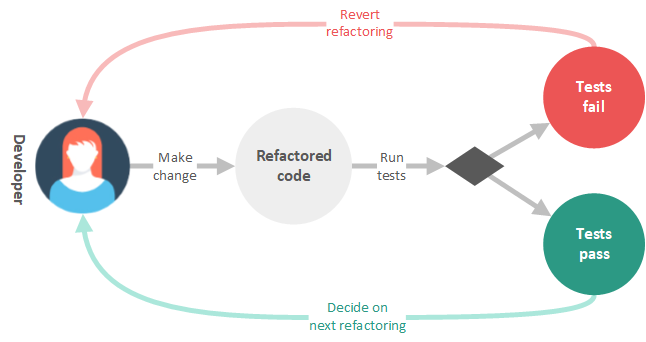
Refactoring is essentially a practice or procedure of enhancing the database or code while maintaining the current functionality. The notion is to change ineffective and also the over-complicated code into more effective, preferably simpler and easier code.

Refactoring of code has also picked up momentum with teams today by following this Agile Software Development approach. Project teams often have limited time to implement new or expand the functionality of the current attributes and code that is clean. The code which is not difficult to comprehend and maintain certainly goes a long way in fulfilling the iteration deadline.

Image result for code refactoring

Need for Code Refactoring

If we are maintaining the initial functionality of this application or module, then a question arises as Why do we even bother refactoring? Well, There are many reasons for which a particular module or piece of code may have to be refactored, such as:

Code Colors
Technical debt
Agile software development strategy, etc..

We will discuss these points in detail in the following sections.

#1) Code Colors:

All of us can understand when the food begins to smell it suggests that it's probably turning bad -- this is true for code also! Code colors are indications a much serious problem may exist within the code.

Following are some Frequent code property:
  • Presence of redundant or equal code.
  • A announced variable that isn't used anywhere in the remaining part of the code.
  • Over complicated code design.
  • Code course that does too little and doesn't justify the occurrence of the class defined. Such classes are referred to as lazy class or freeloader.
  • The existence of too many loops and conditions having the capability to be broken up and simplified.
  • Code construct in a manner that a change in one portion of code demands that the change to be implemented in the other places as well.
  • Code property become more obvious with passing moment. Since the program or system develops, finally these code aromas start affecting the code development, upkeep and even system the performance in extreme situations.

 Related image

#2) Technical Debt:

While creating a program, during the limited time and resources readily available, often we may take shortcuts to accomplish the desired effects.

Think about a feature that has to be added to a current module. After discussion, the group narrows down two approaches to add this feature. Approach A, takes two sprints to send, are the approved long-term strategy. Strategy B takes just 5 days to send is a messy hard-coded hack that is intended to simply service the module at short term.

In case the team is under pressure to supply the characteristic within a restricted time, then they may agree to follow Procedure B for now and add Procedure A from the backlog for future. Using this method, this group just created the technical debt for themselves.

#3) Following Agile Software Development Approach:

Agile software development strategy advocates incremental improvement. Without clean, well-structured and easy to maintain code, it wouldn't be possible for groups to extend the present code with each iteration. If the code has been changed without proper refactoring, then it could bring about code smells or specialized debt.

Why a QA Must Know About Refactoring?


All we discussed until now in this tutorial appears to be associated with coding and resembles the kind of things a developer should worry about.

Subsequently, why are we discussing this unrelated theory in Software Testing? Read the rest of this tutorial to get the answer to this question.

#1) For Unit Testers/Developers

Even though refactoring the code, even as new code is being added, old courses are being upgraded, new classes have been added, and present Unit evaluations may now neglect. Additionally, for legacy systems, there may not be a unit tests employed in any respect. This new unit tests will need to be made and set up from scratch in the vast majority of cases.

#2) For Testers

When a feature is being refactored (considering we aren't adding any new operation ), the understanding is that following the required changes are completed, the majority of the operation for your end-user should stay the same.

As a tester, refactoring of code approximately equates to in-depth testing + regression testing. In-depth testing need to include all the current user flows to make sure that plugins are working as before.

Image result for code refactoring

Regression testing of the entire application (or impacted areas) is required to make sure that upgrading a module didn't unintentionally break the functionality of their other modules.
User acceptance tests will likely be important and these evaluations need to maneuver before the product can be declared ready for launch.

Also, another evaluation required such as load evaluations, safety evaluation etc. would also need to be executed as required.

#3) Automation Evaluation Engineers

Refactoring of code can cause operational and non invasive automation scripts to fail.

This may occur Because of the following reasons:

If the page objects change as part of the refactoring campaign and if your Selenium automation scripts rely on the page objects, then the scripts will fail and would need to get upgraded.

When there were minor modifications, then it redirects those Which Were added or removed during refactoring, and existing automation scripts would fail and would Have to Be updated
It is recommended that the functional automation evaluations should just be installed after a feature is stable, otherwise it is going to lead to a lot of rework since the attribute evolves.

Being a developer of automation evaluations, automation test engineers must also think as a developer and aim to create a clean and simple to keep code. Most of the IDE's like IntelliJ IDEA, Eclipse etc., comprise in-built refactoring menu using commonly used refactoring approaches for simple reference.

Wednesday, October 17, 2018

Why We Need Load Testing

Load-testing is, in reality, part of this larger performance screening frame.  Together with loading testing, then we are able to comprehend the method by which the machine will act under serious loading requirements.

 However, think about all of those additional moving regions of the technique?  The ex-treme load is only one problem that a system may confront.  Just how can we know all of the limitations of an individual machine?  Just how can people figure out exactly what portion of this system will misbehave in the true moment?  This really is the area where overall performance screening comes in to film.

What exactly is Load Testing?

Load-testing may be your testing that's completed to see the way many different elements of the machine are running underneath a specified position. Useful resource use, scalability, and dependability of the goods may also be confirmed underneath this screening. 


This load-testing is, in reality, a subset of this wider operation technology, that will be dedicated to addressing operation problems within the plan and design of the program item.  Planning these load evaluations is really quite essential towards the equilibrium of one's own website.


Load-testing enables you to quantify your site's caliber of agency operation primarily based on real client behavior.  Not exactly all of the loading testing applications and also frame works follow using the classical loading screening paradigm: whenever clients see your internet site, a script recorder displays the communicating after which creates applicable discussion scripts.

A loading generator attempts to replay the listed scripts, that can be altered together with different evaluation parameters prior to synthesizing. 

During the playoff treatment, the hardware and applications numbers will probably be tracked and accumulated from the conductor, these numbers incorporate the CPU, memory, and disc IO of their bodily servers and also the answer period, throughput of the machine under evaluation and in last.

Here are some reason why we need load testing for the web applications 

  1. Tuning the different technology stack components
  2. Detect hardware issues or hardware/VM related problems, like a limitation on the number of threads or file descriptors configured on the system
  3. When your article reaches the first page on Hacker News, but your website is down you regret you haven’t considered load testing previously
  4. There is a need to know how many parallel users your website can handle
  5. Any errors appear to the end users and how are these going to affect their journey


Thursday, September 13, 2018

4 Tips for Application-Level Performance Testing


In an economy where applications have become the heart of almost every business, you get less than one second to impress your user.

In this limited time, you can only impress your user by ensuring efficient application performance and providing quality of your customer's digital experience. To ensure performance quality extensively, a complete layered approach should be used to integrate protocol level performance testing, traditional performance and load testing with application-level performance testing. Testing application performance should be executed as quickly as possible in the development lifecycle to avoid poor performance and ensure user customer retention. Given below are some essential tips for Application-Level Performance Testing.

User Experience

User experience sometimes cannot be properly assessed by your testers or developers. Their understanding of the application creates unintended blindness that stops them from perceiving problems. User experience can be best assessed by real users, an external user experience expert or both. The Certain response time of application behavior may look usual for one user but will boost other users to uninstall it. Preferably it is advised to use as many external people in your performance testing as possible so you can analyze feedback reviews to recognize their opinion about the app. The more you do straight, the better it will be long term.

Crowd Testing

Crowd testing lets you increase the benefit of different mindsets, geographies, configurations, handsets, and more. Run a load session where you ask hundreds, or even thousands, of real users to use your application in certain load time. Offer incentives to the users to report problems to you; it can be either by dedicated communities, by social media, or by crowd sourcing companies. Crowd Testing is about as close to real life process as you want it to be and can be a kind of hybrid load.

Load Testing

A functional defect can only occur under a particular load; it would be tough to find and replicate that defect. Load testing services can help in measuring and evaluating the user experience under varied load. By increasing the load, i.e. by increasing the number of concurrent users, you can check the behavior of the application under that load. Response time and staying power of the application can be monitored accurately while the application is under a specific load. Load testing services can be performed to make sure the amount of load that can be withstood by the application.

Testing Functional Scenarios with Different Connection Qualities

Testing your application with different connection qualities and types, locations, and cellular operators can give you the confidence that is needed by the application to perform reliably and consistently across a wide range of infrastructures. Moreover, you get to see the app performing when the user changes its network from 3G to 4G or a private network like LAN or WiFi.